Why the name?
Ants as a relevant source of inspiration
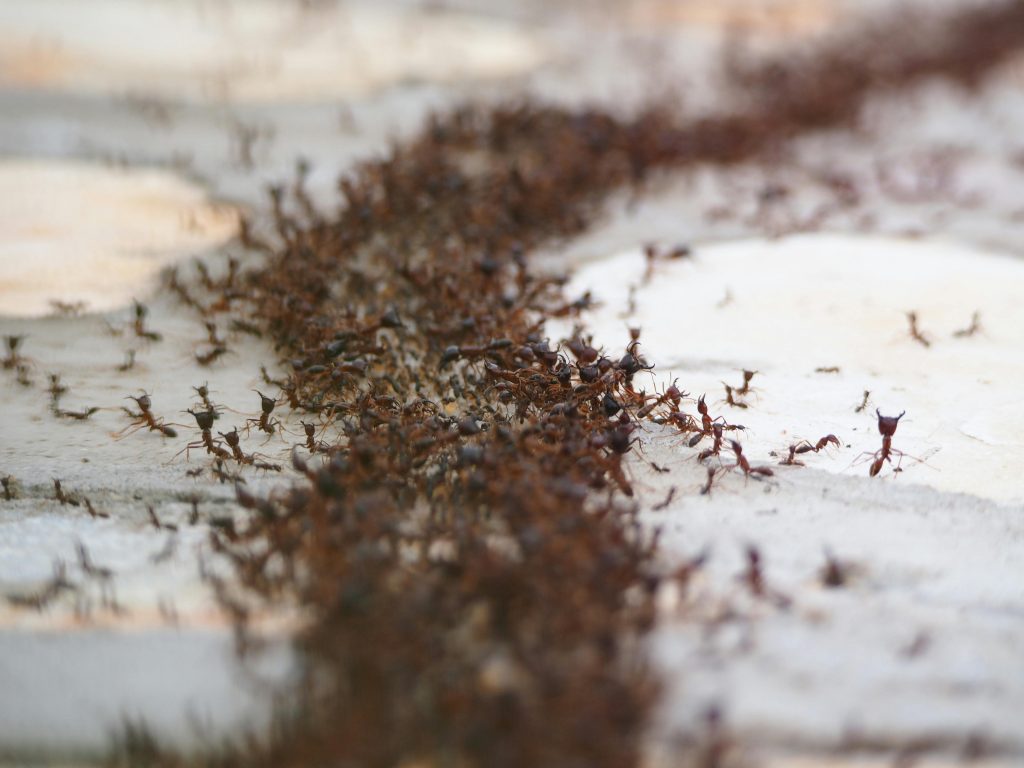
Dorylinae: “The subfamily is a monophyletic group of predatory ants, occurring throughout most of the tropical and subtropical regions of the world, with an appreciable number of species in warm temperate environments. The relatively few dorylines for which foraging biology is known usually prey on other ants or social insects, although notable exceptions occur and several of the charismatic ‘army ants’ evolved more generalized predatory habits.” – Marek Borowiec
Dorylid ants, also called driver ants or army ants, are some of the most formidable insects in the world and can constitute a threat even to humans when foraging for food. Organized in highly structured colonies that can comprise up to several million individuals, they exhibit caste polymorphism (i.e., physical specialisation of individuals depending on their role in the colony) and communicate through pheromones (i.e., they won’t write poetry, but still can pass along messages to coordinate foraging, defensive manoeuvres, load carrying, etc.).
When looked at through the prism of engineering, Dorylid ants are thus a successful and well-documented example of a large-scale system of agents that is:
- comprised of a large number of individuals capable of self-organizing into smaller functional units in a task-dependent manner;
- capable of mounting efficient defensive and offensive actions against a wide range of threats, while also carrying out all the operations necessary to the survival of the colony;
- exhibiting a complex organizational structure that is both adaptive and emergent, this structure being mediated by minimalistic specialisation and communication capabilities.
As such, they represent an incredibly relevant blueprint for swarm systems of cheap, semi-autonomous attritionable agents – be they comprised of any mix of drones, manned and unmanned vehicles, or networked sensors. He who can efficiently implement this blueprint will gain a decisive edge on the battlefield.