System-d
System-d is the agent-level distributed execution framework that implements the operational capabilities using the control-plane services provided by Plexus.
With System-d, every operational entity hosts a common software foundation and can dynamically assume any role required by the mission provided they can express the right Capability Profile. Instead of relying on rigid predefined roles, System-d thus continuously adapts the operational structure to the available resources. It gracefully handles down-times, degraded communications and attrition, thereby allowing heterogeneous teams of humans, vehicles, sensors and autonomous platforms to operate as a resilient distributed system. This common execution model simplifies deployment, improves scalability and enables the rapid integration of new capabilities without redesigning the overall architecture.
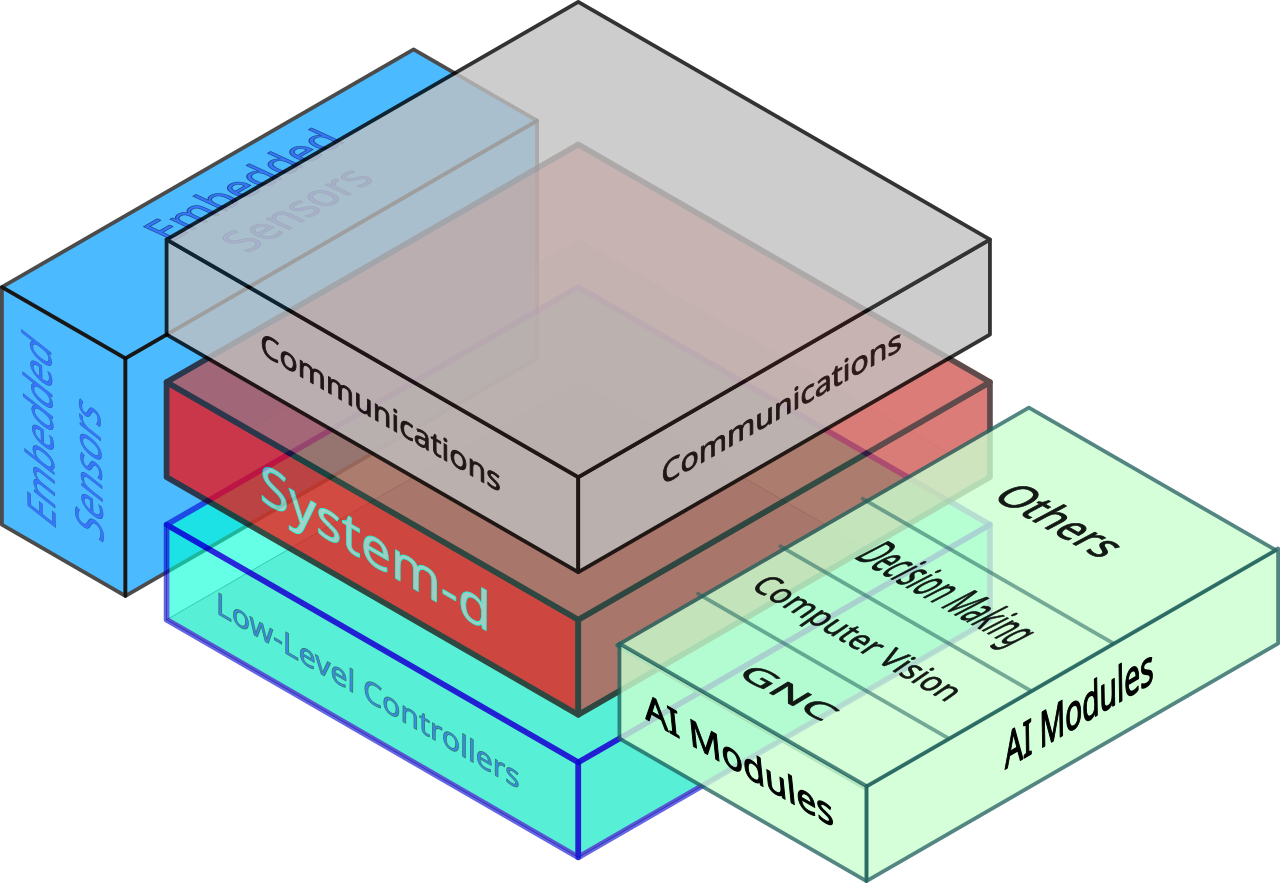
System-d is meant to run on every operational entity that must be integrated through Plexus. There, it occupies a software architectural space between the communication layer, AI modules, sensors and low-level controllers (e.g., for a quadcopter drone, the flight controller). It is designed to contribute along several dimensions:
- hosting mission logic and implementing mission-level behaviors;
- managing agent-level communications across the data plane while interfacing with the Plexus control plane;
- Integrating AI modules (e.g., vision, navigation and decision-making), embedded sensors (e.g., IMUs and torque sensors) and low-level controllers (e.g., robotic middleware, flight controller, etc.);
- surfacing distributed operational state to mission logic through its interface with Plexus.